Disclaimer: This post is a work of fiction. However, resemblance to any person living or dead is not coincidental. They are real people some of them are my friends. I have merrily caricatured them. My apologies to the lay reader. This post is not for everyone and can only be understood and contextually appreciated by those who have been following Libertarian bloggers Crystal Blur's blog and Desipundit controversy over deleting comments.
continued from Episode 2: Coments comments everywhere, not a sensible one to read
Episode 3: Meet the spoofer
(Crystal Blur takes Ganpati and Vyasa in a corner. They do not want to attract undue attention to themselves. The three start reading the blog.)
Narrator: Presenting Crystal Blur, the latest sensation on the blogosphere circuit. Her experiments with Contexual Sexualisation of Sacred Lore… ooops! I meant Contextual Contemporarization of Sacred Lore and her interpretation/spoof/remix of parts of Mahabharat has had readers weeping with laughter. It is rumoured that she is currently in talks with the producers of Sex and the city for a proposed Indian spin off titled Sex and the city of Hastinapur. Indian girlfriends began feeling the heat because of Ms. Blur. Their dewy-eyed boyfriends kept gushing aloud how Ms. Blur thought exactly like them. The girlfriends were smart enough to read this as subtle exhortation towards being more Blur-like. It was one such jealous girlfriend who started the rumour that Ms. Blur is actually a man. However, she did not just stop there. She went ahead and said that not only was Blur a man, but horrors of horrors, was also gay! Rumours flew around that Blur was taking aashraya under a female pseudonym just to promote a gay lifestyle amongst Indians. “She is even calling our Bheeshma pitamaha gay!” was the damning irrefutable proof our jealous girlfriend provided to her grapevine circuit. But as you can clearly see that was just a load of asuri buckwaas.
Ganpati: You should take some inspiration from this blog Vyasa. Look at the names here - Dilip, Gaurav, Shivam, Nilu etc. How short and simple! Don’t you have any shame in making me write those fit-for-spelling-bee-finals 20 character tongue twisters as names? An elephant’s tongue is not as flexible as a human's you know.
Vyasa: Ganpati, for someone who styles himself as God of wisdom I must say you have a terrible memory. You seem to have forgotten our conversation in the beginning of chapter 1. I could not have been clearer on this point. As far I am concerned, size does matter and therefore the long name policy stays.
Crystal Blur: Shhh! You two. Let me read.
(Meanwhile Gautam Bastian enters the stage. Chants of "Hayekum sharanam gacchami!" reverberate in the background)
Narrator: Gautam is an aspiring Buddha. He saw humanity’s suffering owing to failed attempts at achieving nirvana through meditation techniques prescribed by socialist Keynesian school of meditation. He therefore has pinned his hopes on the Libertarian Austrian school. This pancham lama of the Cartel loves studying arcane scriptures. He is known for his vast collection of essays on economics scoured from all over the Internet. At any given instance he can bewilder you with 4-5 links to 20-page essay, which you are better off not reading. He knows that and uses this trick to silence our leftists when he no longer wishes to indulge them in further discussion. Had our blogosphere leftists' been a little more Wikipedia savvy, they would have written a wiki post labelling this bombarding of links with a creative name and terming it a logical fallacy. And the next time any Libertarian even linked to a 200 word article, they could have pointed them to this page immediately. But as you all know by experience socialists are slow learners.
(Gautam moves towards the computer to type his comment)
Gautam Bastian says... comment posted on December 28, 2005 3:06AM
I don’t see how this post undermines any Libertarian arguments. In fact, this proves that when Bleeding Heart Liberals (BHLs) do their job of protesting faithfully while the airlines, media, mobile companies, shopkeepers, carpenters do their jobs simultaneously, the economy runs smoothly. This is like division of labour in action. Read this essay on I, Pencil about the complexity involved in the making of a single pencil. Aah! The beauty and joys of the wheels of the economy turning without anyone actually turning the wheel are a necessary and sufficient condition to achieve nirvana. I dread to imagine a world without I, Pencil where Mridula might have had to lodge anti-capitalistic protests, knit woolens, update blogs, teach economics and also clean toilets. Would you enjoy cleaning toilets instead of spending time reading the essays I provide you on economics Mridula?
Narrator: If I were Mridula I would have chosen the cleaning toilets option. It's quicker and less despicable than reading those dull essays containing such words like network externalities and eminent domain etc.
(Mridula returns to check whether anyone has responded to her call for Guerrilla attack on fort Desipundit where Vulturo has been holed up since he deleted Mridula’s comments)
Narrator: I wonder if it is only me who finds it ironic that Libertarians derive support from a collectively owned entity like Desipundit. Hmm.
(Mridula sees that no one has responded to her call. And adding insult to injury was Gautam hijacking leftist agenda and projecting his Libertarian philosophy on Chetan’s post.)
Mridula says... comment posted on December 28, 2005 3:30AM
@ Comrades: That was the worst ad-hominem attack. Gautam is calling us toilet cleaners. These pampered bourgeois Libertarians kids! What are you waiting for? Attack Desipundit. Let us take down their last bastian… oops! I meant bastion.
@Gautam Bastian: Tu mujhe bahar mil! Have ‘Indian blog classical liberals’ read anything more after Adam Smith on division of labor? Looking at your crass uncouth norms of behaviour with a lady, I am certain you have never read about the visible hand of norms and also not felt the visible hand of Mridula on your cheeks. Remember, just studying Econ 101 not an economist make!
(Mridula leaves. Vyasa has followed this entire episode)
Vyasa: Look Ganpati this Mahablogartha has already reached Kurukshetra battlefield. Your habit of procrastination will ruin my chances at making it to the Hastinapur Times bestseller list. And you Crystal Blur... Let me be frank with you. I am not comfortable with this idea of launching a remix version written by you immediately after my novel is published. I was never into remixes. I am a fan of Lata Mangeshkar who belongs to my generation and I share her views about remixes It's just that the publishers managed to glibly convince me about market pressures and by telling me that a sexied up version would draw 18-35 age group of yuppy readers. This is why I hate the markets! That a remixed sexied up spoof is required to incite their curiosity to read mythology. Sigh!
Crystal: Oh do stop whining. Haven’t you seen how it is the markets that have created buzz around your novel and my remix? Had we not paid the PR agency a fat sum, do you think prominent bloggers like Desipundit, Shivam and Gaurav would have ever linked to us using superlatives, driving so much traffic our way? Don't be naive. You are new to the blogosphere you don't know how it runs via old boy's network. Be realistic. And Vyasa c’mon for someone who claims not to be a virgin you sound unbelievably prude. What is it with you and Lata anyways? I will introduce you to Sunidhi Chauhan at the next book launch, I promise.
(Vyasa seems placated. Hawkeye enters the stage)
Update: Read Episode 4: Tu tu main main
Monday, January 09, 2006
Mahablogartha: Contemporary Contextualisation of Blogosphere Rants or CCBR Part 3

Sunday, January 08, 2006
Mahablogartha: Contemporary Contextualisation of Blogosphere Rants or CCBR Part 2
Disclaimer: This post is a work of fiction. However, resemblance to any person living or dead is not coincidental. They are real people some of them are my friends. I have merrily caricatured them. My apologies to the lay reader. This post is not for everyone and can only be understood and contextually appreciated by those who followed the controversy over my long comment against Libertarians and those who have a vague idea about contents of Amit, Gaurav and Ravikiran along with Shivam, Mridula Dilip D'Souza Great bong and Nilu's blogs.
continued from Episode I: Liberterminator 2
Episode II:Comments comments everywhere not a sensible one to read.
(A blog reader who goes by the name Indian or North Indian and who is the star commenter on Greatbong's blog enters the stage)
Narrator: This character has problems understanding meaning of the words such as satire, sarcasm, irony etc. It is a serious mental condition that afflicts a tiny minority who can be easily found in the comment section of Great Bong.
(Indian proceeds to sit on the computer and types his comment)
Indian says... posted on December 27, 2005 9:03 PM
Chetan thinks he knows economy? Economy my foot you should be sent to 3rd grade you oxymoron! Notice how he licks Laloo’s boots there. I bet that is because he is seeking a ticket from RJD. Only Indian politicians must be reading this blog. It caters only to their intellectual level. I bet he is that dickhead Ganguly’s ardent supporter. Some Chetan Chatterjee or something I am sure. A Bengali, Laloo supporter, commie sympathizer and a Ganguly lover to boot! Lord save India.
(TTG enters. @#^#@c &#% %@*# he keep uttering unintelligeble expletives while reading)
TTG says... comment posted on December 27, 2005 9:35PM
What the f***! On some other day I would have ranted but after reading this piece my throat has gone dry out of expletives.
(Seven Times Six enters the blog takes a quick glance at the article, reads skipping 10 lines at a time and then goes on to bang his comment)
Narrator: Chetan is finished now. Seven Times Six has read Atlas Shrugged 42 times and daily recites John Galt’s speech as morning prayer. Looks like this is going to be a lot of fun.
Seven_Times_Six says... comment posted on December 27, 2005 10:13 PM
Ugh. And what exactly is Chetan trying to say? Such backdoor statist apologists with uber ethical conceit! You make my blood boil!!!!! You are out to ruin our nation. Perhaps somebody (Ravikiran/Sauvik?) could start a discussion on some of the implementation aspects of an incentivized NGOisation of India?
(Shivam enters. Reads the comments goes towards the computer for commenting)
Shivam says... comment posted on December 27, 2005 10:13 PM
I am kicked about this Chetan. You have kicked my Libertarian friends real hard there. Now lets see what magical logical fallacy they conjure up to save their skin. And by the way I disagree on one point. Globalisations’ most celebrated baby is those horrid sweatshop call centres. The BHLs may come next. And Chetan I suggest you delete the comment by Indian and TTG. You ought to tell them that D***head and F*** are words fit to be in a urinal not on your blog.
(Wannabe Cartelian makes an entry. Reads the post twice. Occupies the Computer for a long time. Keeps reading all the wikipedia posts on Logical fallacies and after about an hours starts dancing while shouting Eureka! at the top of his lungs.)
Wannabe Cartelian: says... comment posted on December 27, 2005 10:43 PM
It is simple really! You are using the Broken Window fallacy. Just because the BHLs disrupt something and help the economy temporarily does not mean anything. The same money could have been productively used elsewhere. Have you ever come across something called opportunity costs? Ugh! And he thinks he is such a know all!
Wannabe Cartelian: (Singing aloud while dancing as he leaves the stage) I think this is it! I have scored it this time round. I am sure Ravikiran, Yazad or Madman will notice this absolute brilliance of mine in penetrating Chetan’s arguments. I better mug up all those fallacies before I sleep. They may call me anytime now for the interview to enter the cartel. I rock!
(Ravikiran enters with a solemn expression. Takes down a few notes and thinks hard. Then proceeds to the computer to type the comment.)
Ravikiran says... comment posted on December 27, 2005 11:23 PM
@Chetan What recursive caricaturing! Even me, the condescendingest cartelian, don’t tread this far out in my war against the non-cartelians. This is just too much.
@Wannabe Cartelians: At first I thought that Chetan was committing the good old Broken Window fallacy. But a closer reading will make it clearer that he is in fact pointing out the Broken Window fallacy. To be precise, he is pointing out that the GDP calculation fails to correct for the broken window problem. Is Chetan right? No. But which part is wrong and why?
Narrator: Ravikiran goes home and poses this same question on his blog. But three days and four trackbacks later the comment section is still blank. Ravikiran then went ahead and posted the answer and wondered aloud whether his blog traffic had dropped because none of the Cartelians could solve the question or whether one of the Cartelians had transmitted his selective amnesia to others. The Cartelians maintained their stoic silence even when the answer was posted and the comment section there too remained blank.
(Desipundit links to the post. Vulturo does not call this post brilliant rather links it without using a adjective. Titles the post Liberterminator Part 2. A trackback can be seen on the blog)
(Nilu enter the stage sneering)
Narrator: Here comes the maanga. He fancies himself as Karna who lost out his rightful place in the cartel to Yudhistira aka Gaurav. Gaurav earned his nicknameYudhistira because of his insistence on following the Dharma of right to freedom of speech during the IIPM fracas. Not many were happy about his assuming the name of a character from Mahabharat.
Nilu says...comment posted on December 28, 2005 1:23 AM
@Ravikiran: Why did you bother to state the obvious? Why are you beating to death these settled issues?
@Chetan I think I have found a replacement for Raapi finally. Chetan you replace Raapi and will be linked as Puke Fest #1 on my blog.
(Mridula enters, reads the comment and rushes to Desipundit)
Narrator: Mridula loved the post and wondered why Vulturo linking to it via Desipundit did not call it brilliant. She goes ahead and poses this question on Desipundit’s comments. Anirudh arrives there at the same moment and thinks that only Libertarian posts are getting tagged as brilliant. He too posts a comment there complaining about double standards. Vulturo sees the two comments and decides he has had enough of hearing backdoor statist positions for the day and goes ahead to delete the two comments. I think this is getting interesting by the minute.
(Mridula enters again, she looks mighty irritated and quickly types in the comment)
Mridula says... comment posted on December 28, 2005 1:23 AM
Sorry for the diversion everyone. But something has happened at Desipundit. Vulturo has deleted our comments. Here we are reclaiming our legacy and ushering in the revolution and all and this chap has the nerve to go on deleting our comments. Comrades it time to attack!
Dilip D’Souza says...comment posted on December 28, 2005 1:53 AM
@Chetan That post was so Heller like. Reminded me of Yossarian. I think what you said needed to be said. I hope this sensitises the city bred yuppies to think about the downtrodden. I just wish you had also spoken about the economic benefits of preventing slum demolition.
Narrator: There are a few anonymous commenters who have nothing better to do so they keep on entering Dilip’s name on technorati throughout the day and follow him wherever he goes.
(Immediately after Dilip leaves, Anonymous enters, the actor playing the part is wearing a saffron hood)
Anonymous says... comment posted on December 28, 2005 2:15 AM
Look at Dilip. Speaking about Hell and all. Peddling all these Christian concepts at the drop of a hat! And why I ask does he need to talk about the slum demolition. Just because all his favourite Muslims stay there!
(Shivam reenters)
Shivam says... comment posted on December 28, 2005 2:15 AM
@Mridula: Vulturo is my friend and therefore Chetan’s friend too. So it shouldn’t bother if he titles it Liberterminator or This post sucks. About deleting your comments, there ought to be a reasonable explanation and Vulturo is a good boy. Let us not jump to conclusions here shall we?
Mridula says... comment posted on December 28, 2005 2:56AM
@Shivam Yes, just because he is your friend does not give him the right to delete my opinions. And yea I will jump to whatever conclusions I deem fit. I don’t need you or your friend to tell me that. More power to your friendship, may it get you linked at DP for 'directly attacking' cartels again and again. I am going now to warn other comrades that we have a spy amidst us. Ugh! Such backdoor rightist Libertarians!
(Crystal Blur enters along with Vyasa and Ganpati )
to be continued...
Update: Read Episode 3: Meet the spoofer
Mahablogartha: Contemporary Contextualisation of Blogosphere Rants or CCBR Part 1
Disclaimer: This post is a work of fiction. However, resemblance to any person living or dead is not coincidental. They are real people some of them are my friends. I have merrily caricatured them. My apologies to the lay reader. This post is not for everyone and can only be understood and contextually appreciated by those who followed the longest comment in the blogosphere controversy and the subsequent discussions.
Episode 1: Liberterminator II
(Lights are dim. A computer is kept on a table at the corner facing the audience. The back of a relaxed chair can be seen behind the table. Another chair sits bang in the middle of the stage. Using a LCD projector, the contents on the screen of the monitor are projected on the back curtain. An idol of Ganpati can be seen kept in a showcase to the right of the room. A door is present on a wooden frame in another corner and the nameplate reads ‘Indian Blogosphere.’ Chetan enters through this door. Spotlight follows him as he sits on the computer and begins typing)
Narrator: This is Chetan, a newbie to the blog world. He has been sulking for long and suffers from severe inferiority complex ever since his girlfriend left him because of his Libertarian leanings. Yes, my friends this fierce Liberterminator of ours was once a Libertarian himself. His girlfriend however was an animal rights activist and had to be hospitalised as she fainted hearing Chetan’s passionate defense of the livelihood and economic freedom of those involved in fir and Shahtoosh trade. Since then Chetan’s misdirected anger at Libertarianism finds outlet on his blog. Shhh! None of his readers are aware of this background.
(While the narrator is recounting the juicy details of Chetan’s breakup, Chetan is furiously typing on his blog and the audience can see his words projected on the curtain)
Chetan: Ever wondered about the hypocrisy of those chest-thumping Libertarians? No na! How did you guys ever let those intellectual pretenders become so influential? I am quite certain you scrutinized the steps of their proof but couldn't find a chink in their armour. But did you bother to check their given conditions? Arre udhar hi to dhokha kha gaya na India! Their axioms only were incorrect. They chose only the ones that would help them reach the QED/hence-proved-that step fastest. It's another matter that you guys have nothing to show as your own set of axioms apart from your good intentions. But those are enough I tell you. Even simple axioms such as good intentions are enough to pierce through their intellectual armour. Tum log bhi na. They beat you black and blue with their stick of wikipedia posts on logical fallacies. Did it ever occur to you that they themselves might have created those posts? Proof, you ask me? Just look at how they react to any small criticisms of wikipedia and you will get your beloved proof. Humph!
(Chetan is now charged up and all and gets up from his seat and addresses the audience directly. What he speaks appears on the screen on his blog)
Chetan: Now come on all of you who are new to the blogosphere, Come ye all, who are upset that the Cartelians don’t link to your blogs. Join me my fellow bloggers, you, whom they unfairly target. Follow me guys, all of you who don’t understand what the Cartelians say but nevertheless are certain they are wrong. And last but not the least all those got-nothing-else-to-do-but-wait-for-the next-flame-throwing-contest-in-the-blogosphere-types, here is your niravana : -
Friends, Blogans, countrymen, lend me your ears;
I come to bury the Cartel, not to praise them;
The evil that men do lives after them,
The good is oft interréd with their bones,
So let it be with the Cartel….The noble Chetan
tells you that the Cartel is ambitious:
If it is indeed so, it is a grievous fault,
And grievously shall the Cartel answer it….
Let us together expose the emperor’s pretense of clothing.
Narrator: Thus began our pompous hero’s journey into the morass of duplicity, sophistry, double standards, crass generalizations and mischaracterizations in the name of arguing for some obscure concept like diversity of opinion.
(Chetan returns to the computer and begins typing a post)
Narrator: Unfortunately, our hero’s popularity fell as fast as it had risen. And this is story of the post and subsequent comments that killed his calls for blogosphere utopia through revolution against the bourgeois Cartel.
Chetan’s Post: The Cartelians always talk about hypocrisy. They love chomping Chomsy, mooring Michael Moore and kicking our Gods of small things. Today I shall expose their intellectual myopia and hypocrisy in the context of leftist intellectuals, environmentalists, human rights activist, animal rights activist, anti-market and anti-globalisation protestors. Henceforth this group will be referred to as BHL (Bleeding Heart Liberals for the uninitiated). Try pinning Cartelians down about who they think is globalisation's most celebrated baby and they will tell you orthogonal things like mobile phones and cable television. Actually, they are lying through their teeth! The coveted title of most celebrated baby should go to the BHLs.
Narrator: (Sneers) I think Chetan is actually taking the blogosphere for a ride. The real purpose behind this post is altogether different. Me thinks he is writing this post in the hope that his former girlfriend comes across it watches him repudiate his Libertarian ideals and takes him back. Tut Tut.
Chetan’s Post: Don’t take my word for it dear readers. Imagine what the global economy would be without the BHLs.
Who do you think keeps afloat the airline industry tottering on the verge of bankruptcy from going bust? Why, the anti-globalisation brigade of course. How? By purchasing tickets to locations such as Cancun, Doha, Brussels, Kyoto and Geneva and that too off-season! Imagine the revenue the airlines generate as these lovers of water cannons come in droves to (enjoy rangpanchami?) err… protest. But have you ever heard these Cartelians acknowledge their contribution? Never. Next time remember that the low airline fare you pay is owing to the benevolence of these BHL’s who have managed to keep the competition intact in the airline industry.
Not convinced? Here’s more…
How do you think these protestors organise? They come from different places across the world/country. How do you think they communicate? Mobile phones and the Internet of course! Now imagine the jump in sales for the mobile companies. Were it not for the protests do you think our anti-market good-intentioned environment friendly BHLs would have ever bought into those unnecessary choices offered by the evil profiteers? And what about Internet advertising? How do you think Yahoo/Google/MSN get their email customers without these guys joining the debate on their groups. They also are forced to use computers thus boosting hardware sales. Self-righteous people that they are, the BHLs are the only ones who pay for their software. Ask the Cartelians whether they use licensed software and they will blame the government for not implementing laws. Shifting the goalposts, anyone?
Still Unconvinced?
Here is the damning proof of their candidature for being the most celebrated babies. The media industry. Arre do you think the industry could have survived one day without BHLs? Were it not for the BHL’s compulsive need to be on camera, how do you think reporters would have gotten their stories. The insensitive parading of the human right abuse victims’ tears by the BHLs is tailor made for the queasy dinnertime visuals during the 9O’clock news. All the sensational issues of the world, all the controversies, shouting in favour of aid for Africa, all the protests, tree-hugging, breast beating all for a good cause; keeping the media industry running. Would you have bought the foreign magazine you never read had it not featured Pamela Anderson wearing cabbage leaves plugging for vegan lifestyle on its cover? All the Rupert Murdochs and Ted Turners of the world have only the BHL to thank for their fortunes.
I am sure by now you are convinced. For those of you who are themselves BHL there is more:
The free market guys only worry about the profits of the big corporations. It is only our dear sensitive BHLs who cater to the small trader. Notice their contribution to the local economy. All the placards they need are built by the humble carpenter. The flags and the confetti are provided by the local storeowner. The local florist gives BHL flowers to plant in a handsome soldiers’ guns. The small shopkeeper in the neighbourhood provides them with Bisleri/Aquafina bottled water. After all, our city bred BHLs have to visit all sort of places and won’t they fall sick if they drink the tap water funded by the result of their lobbying for socialist programs. Mind you, this in no way deters them from supporting our Great Leader Laloo’s attempts at banning cold drink/mineral water sale in trains. Unlike the Cartelians the BHLs can live with contradictions. Ever wondered what courage and commitment to their cause must it take to live a life filled with such glaring contradictions? How can the Libertarians be blind to it I don’t understand? No they are not blind. They have kept us blind with their obscuratist control of the blogosphere. They never have and never will acknowledge the contribution to the GDP by the BHLs. Their mantra of GDP=development has no place for the GDP contributions by our BHLs. So yes, let us reclaim what rightfully belongs to the left of center. We run this economy and we shall regulate it!
Narrator: I bet his girlfriend will take this juvenile ignoramus attempt at finding a common ground as a vindication of her decision to dump him. On a serious note, this post proved to be the last of Chetan. The comment section killed him.
(After that valiant effort at penning the post Chetan leaves the stage with his chest pumped up)
(And now the readers start trickling in on the stage to read his blog. Most readers leave after taking a look at the length of the post. Those who do manage to read halfway are riled enough to comment immediately. They go to the computer table and start banging their comment on the computer as the audience watches it on screen)
(A blog reader who goes by the name Indian or North Indian and who is the star commenter on Greatbong's blog enters the stage)
Narrator: This character has problems understanding meaning of the words such as satire, sarcasm, irony etc. It is a serious mental condition that afflicts a tiny minority who can be easily found in the comment section of Great Bong.
(Indian proceeds to sit on the computer and types his comment)
Indian says... posted on December 27, 2005 9:03 PM
Chetan thinks he knows economy? Economy my foot you should be sent to 3rd grade you oxymoron! Notice how he licks Laloo’s boots there. I bet that is because he is seeking a ticket from RJD. Only Indian politicians must be reading this blog. It caters only to their intellectual level. I bet he is that dickhead Ganguly’s ardent supporter. Some Chetan Chatterjee or something I am sure. A Bengali, Laloo supporter, commie sympathizer and a Ganguly lover to boot! Lord save India.
to be continued..
Update: Read Episode 2: Comments comments everywhere, not a sensible one to read
Tuesday, December 27, 2005
A tsunami of dilemmas
Last year after the tragic tsunami I came across the phenomenon of on-campus fund raising in the United States. It exposed me to a whole different ethos. At first I felt queasy at the manner in which the Americans went about raising funds, but over a period of time I began to appreciate their approach better. Yet, one year after, and having seen lot of other responses to natural disasters, I still haven't resolved my dilemmas completely.
After the school reconvened for Spring in January 2005, I was hit with flyers advertising free pizzas for coming to Room 240 at 5:00 pm. The words Free Pizzas were in a large bold font and below that in a smaller font the solemn purpose for the meet was stated. "To organise a comprehensive strategy for fund raising for the tsunami victims."
It had been just four months in the States for me and I carried a lot of baggage in terms of my Indian socio-cultural background. At that time I remember I found it jarring that people had to be induced by offering free pizzas and a soda for the noble objective of raising aid money for the tragic tsunami victims.
I went into the meeting all eager to contribute and help gather more funds. Almost 50-60 students showed up, out of which only 10-12 people participated in the actual discussions. Others were there for the free pizza. (The organisers were clever enough not to open the boxes till the meeting was over) The discussions were mainly about how to go about organising funds. They debated whether a party at the neighbourhood food joint would be more profitable or a party at a neighbourhood bar during the happy hour. In the end they decided to do both. The way these parties generate funds is that people are invited to come in large numbers at the restaurant/bar. The restaurant/bar owner gets a lot of customers at one go and he promises 15-20% of the bill in donation. So more the people having fun and spending, the more the donations collected. Somebody also came up with the idea of hiring a DJ and having a dance party on campus with tickets selling for $30. In one of my conversation with an NRI kid, who was coordinating the effort, she talked about how by taking this initiative she has enhanced her CV and improved her job prospects etc. I am not clear about this but apparently you earn some credits from your school for community service or something. This seemed to be a common thing here.
For me, the naïve 'fresh off the boat' Indian student, this was unbelievable. With my middle class background, the only fundraising I knew of was passing around a tin dabba covered with white paper and 'DONATE' written on it with a green sketch pen. Another form of fundraising I remembered was those embarrassing situations when as school going kids we were given a sheet of paper by Helpage India/Blind Youth Association and went about apartment complexes seeking money for those organisations. We expended all the goodwill we had earned with our neighbours (by not playing cricket on Saturday afternoons while they slept or by allowing their little kids to be part of the apartment cricket team) for this purpose. It was awkward and embarrassing. I used to pray that not every one of them follow the example of the neighbour who had proudly put in the amount of Rs. 2 besides his signature.Somehow my rich friends used to come up with amounts like Rs.1500 with Rs. 1400 donated by their parents, while I could gather only Rs.150. But I am digressing.
So coming from there, it was a huge leap for me into a setting where there were free pizzas and cans of coke just for offering suggestions, where it was ok to talk about enjoying yourself by dancing to raunchy hip hop and drinking alcohol; all for the cause of raising money for those tragic victims who were homeless and crying their eyes out. It seemed to bother no one's conscience but my own that I will be having a wonderful time drinking booze and having good food while the people in my country have lost thousands of their loved ones. I was raised in a home where Diwali and Ganpati celebrations used to be cancelled if a distant relative had died as a mark of respect. I remembered at the time of Bhuj earthquake I was in Fergusson College in Pune and a similar student body had been formed to organise a response. But there were no parties at Vaishali restaurant nor was there any talk of a 'Earthquake Bash' at the local dance club. Talk only centered around bringing more and more people to donate. If I remember right many colleges cancelled their annual college festivals as a mark of respect and mourning.
In India donation has to be associated with sacrifice. Otherwise it becomes meaningless. Newspapers may not carry stories about an industrialist donating 20 lakhs for a cause, but there will always be stories about how a retired schoolteacher with a salary of Rs.2,000 donated his lifetime savings of Rs. 20,000 to the victims etc. Indians empathise with that teacher more than the industrialist whose money actually makes all the difference. The sense of sacrifice is valued more than ruthless utilitarian view of what benefits more in real world scenario in absolute terms
But somehow the students here did not have any such compunctions about not sacrificing anything. They weren't sacrificing anything. If not the parties they would have spent the money at some other bar anyways. The money they were spending was not pinching them in any manner. They faced no such moral dilemmas as I did. And this was what set me thinking. Looking at it from a moral relativistic perspective this just proved that what I thought as moral was not an American's idea of morality. What I considered to be universally valid conscience prick was not universal at all. And when it comes down to it, the funds generated through the parties the Americans arranged, far outweighed any funds I might have collected going around holding a dabba in my hand.
It is the classic quandary of ends and means. If only I disregard the means, and focus on the ends, yes, the American system of fund raising works great. I am forced to acknowledge that. By incentivising fund raising for the youth, the amount earned is just phenomenal. I am not blind to the fact that had it not been for those parties, the donations would have been far less monetarily. So what is wrong about spending on alcohol and having good food yourself if in the end it is all for a good cause? Surely, my going into mourning was not going to help those Tsunami victims at all. They wouldn't know and wouldn't care less if I cried my eyes out for them or went on a fast or if I drank alcohol or ate good food or flirted with a girl on the dance floor. So long as they receive funds without hurting their own dignity in the process, I don't envisage a protest from their side about the source of funds. In fact this idea is brilliant. Everyone benefits. The students were going to spend their Saturday night out anyways. They merely spent it in that particular club. The club owner made a profit regardless. He did not lose any money. If his profit margin was 30%, he got twice the number of customers on a normal day and so in numerical terms his profits were more and so donating 20% of those was no big deal for him as he would have earned a 10% profit regardless. Add to this the 'look good on CV' argument. If by linking fundraising to a PR campaign for the student one can ensure enthusiastic participation, why not? It takes nothing away from the fund raising.
Apart from that, implicit in the idea of going into mourning is lack of spending and therefore loss to the economy. Whereas an American is actually spending and pouring money into the economy and the health of American economy might benefit the Tsunami victim through the invisible hand of the market. So from an economic perspective this is an open and shut case. In fact there was no case here at all. If raising money is the goal that is what should be the focus. So I have to concede that this model is great. Whether it will be replicated in India, I do not know. It is possible. However, a more creative alternative might be finding better ways for incentivising the sense of sacrifice while adopting this model. If one can weave that sense of sacrifice into an Indian fundraising party the revenue might be much more rather than just a consumerist feast.
Bottomline, I am sold out for this American idea for fundraising.
Then what is the word dilemma doing in the headline of this post? I have resolved my compunctions at this 'partying' model of fundraising but am still confused about the implications if this model is stretched any further.
The problem with a morally relativistic perspective is that only your imagination is the limit. Would you be equally comfortable had a brothel in Amsterdam organised a similar fund raising by inviting patrons to spend a night in their brothels? Economically there is nothing wrong. One can argue that an unintended consequence may be that a family man may be tempted to cheat on his wife 'for a good cause' etc. But even then the loss to the world economy by a couple of couples separating is far less than the gains by the revenue generated. The same may be the case about Dawood Ibrahim writing a check of 20 crores for tsunami relief. Would you accept it? Do the ends justify the means in these cases? Should laws of economics alone determine all human decisions? I have not resolved these dilemmas. Feel free to post what you think about this in the comments section.
P.S. Before posting your response do read this article from The Week's anniversary special issue about how Indians think. It captures the Indian mind perfectly and is aptly titled "We are like this only."
Wednesday, December 21, 2005
Of bats, balls and corporate brains
Guys, how many times have women accused you of thinking from the crotch? A new study proves that their question wasn't way off the mark. There is indeed a strong correlation between balls and brains. Scientists have established an inversely proportional relationship between the size of balls(testes) and size of the brain. In short the bigger the brain, smaller the balls and vice versa.
The December 10 issue of the Economist carried this article under the section animal behaviour. The scientists came to this conclusion after studying 334 species of bats, the second-largest group of mammals. (The largest group of mammals comprises of rodents.)
The hypothesis they were testing came in two parts. The first was that in any given species, the average male's testis size as a fraction of body weight will depend on the behaviour of that species' females-in particular, how promiscuous those females are. The second was that, given that brain tissue and testis tissue are among the most expensive to maintain physiologically, and that bats have a very tight energy budget, bigger balls would result in smaller brains.So guys the next time a woman blames you for thinking from your crotch, immediately shift the blame back on her promiscuous behaviour, which has limited the size of your brain.
The team knew, from work done some time ago, that the first part of their hypothesis is true in primates. Greater promiscuity in females does, indeed, lead to bigger testes, presumably because a male needs to make more sperm to have a fighting chance of fathering offspring, if those sperm are competing with sperm from a lot of other males. Gorillas, which discourage dalliances between other males and the females of their harem, have small testes. Chimpanzees, among whom females mate widely, have large ones. Human testes lie between these two extremes.
Bat testes range from 0.11% of body weight in the African yellow-winged bat, to a whacking 8.4% in the generously endowed Rafinesque's big-eared [sic] bat. (The largest primate testes by contrast, those of the crab-eating macaque, are a mere 0.75% of body mass.) And the small balls were indeed found in species where females were monogamous (though they might be members of harems), while the large ones were found in species where females mated widely.The most fascinating aspect however is the reason why this happens. It is the tight energy budget available for the body that enforces such trade offs. The word trade offs immediately made me think and triggered an analogy of this situation to a company/corporate setting. Everyone would agree that the Research and Development wing represents the brain while the marketing department is the balls of the company. (My apologies. Please bear with me. It is not my intention to speculate on the brain and testicular sizes of those of you working in marketing and R&D departments). And similarly the consumers are like the female of the species. Given the tight budgets, there is always a trade off between the budgets for the two departments, R&D and Marketing. Interestingly the results of the study can be seen in action in a corporate setting. The more the consumers (more promiscuous the females), the bigger the marketing departments (balls), while lesser the consumers (less promiscuous females), more the R&D budgets. Just think about it. As a company grows bigger, the market demands force it to focus on marketing for growth, while for a smaller company, the best bet to make it big is to focus on its R&D. So even though Microsoft became a leader through its R&D, it shifted its focus to Marketing as it got bigger. Same thing can be seen if you study the history of other technology firms.
This analogy also works in case of blogs. The newspapers are the bigger companies with large number of consumers, so they can afford to overlook their editorial section and focus on the marketing, ala Times of India. Whereas blogs have to exclusively focus on the intellection/editorial aspect to keep their readers hooked. When the scientists carry out the study on humans, I suggest they should study the ball sizes of bloggers. They might come up with some embarrassing results. :) A conversation with my roommate was revealing. I was teasing him for not following blogs. He shot back saying, "how will I find time for porn if I 'waste time' on blogs?"
Jokes apart. This made me wonder how analogous is this relationship between a corporation and a human body? For instance the digestive system can be likened to the production department, the nervous system is just like the corporate communication department. It seems to me that the study of human body may hold some valuable lessons for the corporations and management students. And if we bring Darwinists into the mix, they might shed light on the analogies between evolution of species and evolution of corporations.
Almost every Economist article ends with a tongue in cheek witticism. That is their trademark and which is one of the reasons it ranks as my favourite magazine. At the end of the article Economist poses the question, is it better to be virile and dim, than impotent and smart?
What say you?
P.S. (When I told an American friend about this study, he shrugged and was surprised that a study was actually needed to prove this. He said, going by the scene in American college campuses, everyone knows that the brainy types hardly receive any attention, while the dumb football players have all the fun.)
I have edited this sentence out of the post as it adds no value to the point being considered and as anonymous in the comment section has pointed out, my American friend wasn't being logical. A footballer uses different aspect of his brain. I stand corrected.
Saturday, December 17, 2005
My gripe against the Libertarian stranglehold of the Indian blogosphere
Those of you coming to my blog curious about the long comment I posted on Shivam's blog and Desipundit, feel free to post your rants and raves here. I have defered to Shivam's request not to make the comment into a post and let it stand as what he characterises as the longest comment in the Indian blogosphere. Once again, my sincere apologies to those Libertarians I inadvertently offended and mischaracterised. I respect you guys and all of you are really intelligent, but I felt muffled on account of your extreme influence in the blogosphere and that kept me going and going and going.
P.S. Incidentally this will also mark as the smallest ever post on my own blog.
Update: There has been a nice back and forth going on about this topic here between me Ravikiran and Eswaran.
Update 2: This discussion has reached its end and it can be followed in its entirety through the 80 comments on Shivam's blog and 58 comments on Despundit. I enjoyed the interaction thoroughly and thank all those who participated. Also special thanks and admiration for the Libertarians, who took this so sportingly even though there was enough provocation.
Sunday, December 04, 2005
Plagiarism, double standards, bloggers and self-interest

Lately the Indian blogosphere has gone hammer and tongs after plagiarism. Journalists and film reviewers are at the receiving end of bloggers’ wrath and sense of indignation. The recent expose of the reviewer Gautaman Bhaskaran from the Hindu left a bitter taste in many readers’ mouths.
While everyone was ranting about the great wrongs that were being committed in the name of journalism, Suyog had a very different take on the issue. He questioned whether our indignation was justified. Whether bloggers ought to have reacted as strongly as they did? He presents an interesting and definitely a thought provoking perspective. I must commend his courage in having the honesty and the balls to write what he wrote knowing the prevalent mood in the blogosphere. We definitely need to challenge our views and not reinforce them by reading similar perspectives and for helping that cause, hats off to Suyog. Despite this, I will argue from a purely self-interest point of view -- plagiarism, at least in the mainstream media will always be a big deal.
Suyog raises the following pertinent points: -
- Anu Malik has lifted innumerable tunes for his movies; so what did you do? Stop listening to his music altogether? Did you mail him and ask him to stop getting inspired? Because the music was plagiarised, did it stop you from buying the CD of Murder because you loved the song “Kaho Na Kaho?”
- Most Bollywood movies are inspired by Hollywood. So if Munnabhai M.B.B.S was inspired Patch Adams, would it make Munnabhai a less enjoyable or a less better film? Once you discovered it was inspired, did you decide not to watch it at all? Did you Blog about it?
- You know all too well that you most Tommy Hilfigers you get in India are fake, didn’t you? Did it stop you from buying them? Did you mail the maker or the textile company about shamelessly copying Tommy’s designs?
- Most drugs and medicines in India are more or less variants of the drugs made after considerable research in United States – and that is why India is now having newer laws on drugs and medicines. So, what do you call Crocin or Anacin? An “inspired” drug? Will you stop having it if you are sick?
- Did you hear that Chinese versions of Energizer batteries work just as well and sell for three times cheaper. You wouldn’t buy it would you?
To this litany I would add that many of the bloggers who blogged about this issue may have been using pirated version of Windows, MS Office and Photoshop not to mention numerous games, and must have hundreds of MP3 songs on their hard disks for which they haven’t paid a paisa to the producers. After reading this, his question seems almost rhetorical, “Is plagiarism really that big a deal?” According to Suyog, in other cases we have learnt to live with such copying and stealing. Over a period of time we have gotten desensitized. He further argues that in near future it wouldn’t matter if a journalist or a blogger plagiarises.
The point is this: Plagiarizing is frankly not that big an issue as it is made out to be through Blog journalism; one just needs to think a little bit beyond the obvious and see that originality as a concept itself is very rare; everything else is more or less plagiarised of one thing.
What he has said applies perfectly to the 'media' that he has cited. I would pose the same question that he asked. Why don't bloggers protest in the above instances, but do so in case of newspapers? If one looks at this ethically (and there is definitely a case for looking at this ethically), the bloggers will fall flat on their faces because of the double standards they adopt. But instead of tackling this by saying that we adopt double standards and should rectify them before we attack anyone else, I think, an interesting question to dwell upon would be, what induces us to adopt these double standards. By dismissing people who protest at plagiarism in news media as people who 'don't see the point' is premature.
Relationship between mainstream news media and readers
What is it that infuriates us when we see plagiarised content in mainstream media? The key word here is media. Suyog’s argument is self-serving because of the broad brush he uses to paint the media. We need to discriminate (pun intended) between the news media and entertainment media. Plagiarising, getting inspired, lifting off etc. will never be tolerated by the public in the mainstream news media. Plagiarism, when it comes to news media (unlike other entertainment media such as films, serials, advertising etc.) is a serious issue because the prime relationship between the news media and the reader/viewer/listener is of trust. We trust the ToI's, Indian Expresses' and Hindu's of this world far more than any film director, musician or cloth maker. The currency in which the public trades with the mainstream media is trust. It is because of this relationship that we buy a particular newspaper or watch a specific news channel.
Consider this. You invest some money into a bank. Later you find out the bank manager starts giving away loans to his friends without mortgage. When you quiz him about it he says, "What's the big deal. Don't you help your friends? Do you protest when others are helping their friends? And so what's wrong when I do it?" What's wrong here is that you expect a certain responsibility on that person's part. The bank is making money because of your trust. Your relationship with the bank is based on trust just like with the newspapers’.
We lend them certain power on our (citizens of a democracy’s) behalf so that news media inform us about the current events and happenings truthfully, first hand and without bias to help us make wise decisions in our personal life. Readers expect the news media to give them as close a picture of reality as they can. For this the journalist has to be closer to reality. Talk to real people, work hard to get phone numbers, discuss with experts from different walks of life. Only then can he/she present us the true picture, not by plagiarising.
In contrast, you beget no loss in any form when you watch plagiarised films, and listen to plagiarised music. Sometimes you knowingly choose to view a film or listen to music knowing that it is plagiarised. In these instances there is a financial gain in such a transaction for you. For instance, when you buy a Chinese made battery or a purchase fake Tommy Hilfiger pant or buy pirated software. So it is to your benefit and therefore you do not protest. (I must state that this does not mean that I support the above things. I am just pointing out the facts and that even the ones who lament hypocrisy are hypocrites themselves and it's better to understand issues taking into consideration human foibles rather than paint it in black and white in an ethical languge.)
Besides, what Suyog mentioned about inspiration, and other things are not applicable to the news media because news by definition is reflection of reality and not a creative endeavor where someone borrows from somebody else, tweaks it a little and melds it with something else and produces something new. Journalism is about getting as closer to the truth as possible not creating layers where there is a greater likelihood of it getting distorted. Creativity involves certain imitation. This is not to be tolerated but even expected. But people don’t like anybody tinkering with reality.
We invest in news media monetarily, psychologically and sociologically. We also invest in the individual journalist who covers the events. For instance, a report by Barkha Dutt is much better regarded than a novice television reporter’s. The same applies for an op-ed piece by renowned journalists such as Shekhar Gupta and Saeed Naqvi. We give regard to their opinions and trust their intelligence. Tomorrow if we find that their opinions were borrowed from someone else, then we will lose respect for them and the next time they write something we wouldn't lay much in store for it. It would be like the story of crying wolf where even when they say something genuine tomorrow you will think they have plagiarised and hence have no say in the matter.
Now you may argue that this is very much true for news articles, but does it apply really to plagiarising in reviews and other feature stories? Will one day readers overlook plagiarisation here? A New York Times review is written with the sensibilities of the New Yorkers and not Indians. Gautaman's review would have been richer had he compared his knowledge of Indian films and personalities. If he had viewed the film from his Indian viewers’ perspective, his readers would have identified better with the film review, rather than the obscure Hollywood figures he quotes to appear sophisticated. Because of his laziness, the reader, who has paid Rs.3.25 to buy the Hindu, suffers. He/she suffers also because after reading the review he/she might never watch the movie because of the interpretation that 'it seems to be too artsy' since he hasn’t heard the big-wigs' names quoted in the article. So he/she might miss out on a good movie because of Gautam’s laziness. This, despite the fact that the reader may have purchased Hindu just to read the review and make a decision about which film to watch. The reviewer is someone with whom the readers develops a relationship. In the Times of India I knew Khalid Mohammed was biased towards Shah Rukh. I knew I rarely agreed with Nikhat Kazmi’s reviews. Readers have a relationship with each of them and would punish them badly if they betray the trust. So yea readers will always make reviewers pay a price if they plagiarise.
Overlooking plagiarism in other media
The other media that Suyog mentioned; films, songs and other stuff don’t have as big a direct impact on our everyday decision making as the news media do. But don’t we trust filmmakers and musicians as well? How many times have we gone to a movie and threw our hands in frustration seeing a badly made copy of a film we have already seen. We do pay Rs.80 for watching the film as against Rs. 2 for purchasing a newspaper, so why don’t we find many people blogging about this? When we (as in urban-centric, college-educated, well-read, upper-middle class) look at plagiarisation in films and music, we automatically assume that rest of India thinks like us. Take the example of Awara Paagal Deewana. I had lost track of the number of movies it borrowed from and so it can be taken as the best example of plagiarism. How many Indians had seen the films from which it was borrowed? The Matrix, The whole nine yards, Mission Impossible 2 and Crouching Tiger Hidden Dragon aren’t the typical movies a man on the street watches. They, more than us, contribute to the profits of the Bollywood producers. They are hardly aware of the copying. And it doesn’t bother them one bit even if they find out it is copied because they wouldn’t have understood the Hollywood plots because of American accents anyways. In fact they have an incentive in patronizing such films, as it saves them money and time in watching the originals.
The same goes for music. How many amongst us (the stereotype mentioned earlier), let alone man on the street Indians had heard the originals before we purchased Anu Mallik’s album? It is only after a geeky music lover boosts his own popularity around college campus talking about the original in an obscure album, that you find out that the song you liked so much was ‘inspired.’ (I remember the first song I came to know was copied was Tamma Tamma Loge… do you think even 0.1% of Indians had heard the original African (or was it Caribbean) song?) Most of the times the word spreads about plagiarism months after the song is released. By that time you have already invested your money. When you find out it is a copy, you are angry but you really like the song, lifted or not. For you as a consumer after having spent Rs.50 buying that cassette it makes no sense to purchase the original music costing Rs.100 (foreign music costs more). Now what is the choice? Definitely cribbing; trying out newly learnt invectives on Mallik and living with your purchase. If the original had been more popular amongst the janta, Anu Mallik would have to kiss his own arse.
And if you think this is not true, consider this. When the song Didi by Middle Eastern singer Khaled was introduced in India it was an instant hit. If you are from Maharashtra you will know that a song’s popularity depends on the number of Ganpati Mandals playing it and believe me even the most rabid Hindu nationalist mandal didn’t have any qualms repeating this song on their speakers. Then Anu Mallik came up with two variations of the same song. But they flopped miserably. No one even remembers them and yet Didi even today strikes a chord. The same happened with Macarena. The original was so popular that the Hindi one never really had a chance. The point I am trying to make is that viewers and listeners do punish plagiarism even in films and music. But only when they haven’t spent their money already and when they do not have a monetary stake or self-interest in supporting the plagiarised material. So though they may be angry at the unethical ways of the musician they know that protesting isn’t going to go anywhere and there is no benefit that can accrue to them.
Now coming to the news media, the relationship is much different here. You spend money on one particular film, music album, piece of clothing etc. only once. You don’t go buy the same cassette everyday or watch the same film in theatres over and over again. But newspapers you buy everyday. Even though the content is different the format and the product is the same. It is a continuous relationship fostered over years. One of the reasons why people don’t stop reading Times of India is this sense of loyalty and habit. So while you may be extremely disappointed after knowing that a film was copied or music was lifted you are smug in the knowledge that you won’t be buying the cassette again or spend Rs. 100 on the film again and protesting harshly on blogs therefore would be of no self-interest to you. Whereas every reader knows that he/she will buy the newspaper tomorrow and will be spending Rs. 3.25*365 every year. If its quality suffers, the reader has to bear with it forever. So the readers protest purely out of self-interest. Apart from that as I already mentioned in my earlier comment, a newspaper’s price is much more than its sale price. It isn’t as simple as ‘for Rs.100 I can buy 40 ToIs’ and hence I should be worried more about plagiarism in films and music than in newspapers. Mainstream media can help you save a lot of money through its news. It can help you make sound financial decisions depending on the political climate. If everyday a new cooperative bank is being exposed for its fraud, a reader will never put his money in cooperative banks. The stock market reporting is another example. A person may never buy a house in a locality where he reads reports of crime everyday. The same applies to film review. Imagine how much a person would lose experientially and monetarily over a year’s time by reading problematic reviews and then choosing to go or not to go to the films. If the newspaper started plagiarizing never telling the reader what he needs to know, never telling him the truth as they see it, merely borrowing from foreign sources, these benefits would vanish. And the reader would definitely switch. So I don’t agree with you at all that over a period of time plagiarism in news media will be no big deal, just as it is not in films and music. It will always be a big deal if it happens in the mainstream news media.
Market perspective
Considering it from a purely Market perspective too plagiarism will be made a big deal. Every entity in the market works towards making it as efficient as possible. And it serves the customers better if this happens. Bloggers by protesting against plagiarism are doing just that. People who don't like Times' articles that are plagiarised through Cosmopolitan may be buying it for its other stories. But since they are paying for the entire Times they have every right to protest. If you notice the reactions to the Hindu plagiarisation, they are all of disbelief. This is because many people pay a high cost (the Hindu is much expensive than Times or Express) for Hindu just because they are so trustworthy and unbiased in their content. So from a marketing perspective, there is nothing really surprising about a customer demanding his right. And the paper that plagiarizes and that breaks its contract of trust with its readers will suffer circulation losses in the long run.
If I were put on a spot here I would admit that plagiarism lifestyle articles and some stupid ‘10 ways to please your man and get him to get your favourite chiffon’ type articles were never a big deal and probably our double standards will eventually not extend to their sphere. Yet, it remains to be seen whether this will actually transpire. As someone who has great faith in the mainstream media despite whatever any blogger may say, I would be unconfortable accepting that. Also there is a prettier, more elegant, less embarrassing way for mainstream media to deal with this issue. Namely, just name the source upfront. Since your readers cannot afford cosmopolitan anyways, they would be glad to read those articles in your paper. All the newspapers will lose is a little revenue paying cosmopolitan and give them credit in the story. But this will be a worthwhile investment as they may save crores on lawsuits and at the same time not lose circulation due to an ethical person backing off. As the market evolves it is not a long shot to expect this to happen. And I am sure it will. Hence yes though today it seems likely that the lifestyle articles will pass into the category of no big deal, but tomorrow I trust the market to bring them into its fold.
So, if anyone has issues when someone argues about plagiarism from an ethical perspective because ethics demands that there be no double standards look at the blogger reaction from the marketing standpoint and it will make much more sense.
Saturday, December 03, 2005
Balbir Pasha ko kya hua tha?

If your answer to the above question was AIDS, then you can collect your free passes for dinner with Pasha by mailing me. You obviously are amongst those blessed beings who were touched by Pasha’s presence in your surroundings. For those unfortunate ones who are trying to remember which of the two camps, Dawood’s or Rajan’s, did Pasha belong to, this post might be a good start.
Balbir Pasha was an everyman who took it upon his shoulders to bear the cross of Indian society’s reluctance to discuss AIDS and sex related issues openly. Like Atlas, he carried the weight of the guilt of entire Mumbai, the metropolis that Suketu Mehta has rightly called a ‘city in heat.’ Pasha chose to a lead a life of ignominy just so that those teeming bambaiyas could know the about AIDS victims and Pasha’s fate did not befall on them. Balbir Pasha was the fictional alter ego of the truck drivers, taxi drivers, jobless and blue collar workers of Mumbai. A wonderful advertising campaign was devised by Lowe woven around his character and I remember it was a hit when it was first unveiled. For months Balbir Pasha was the most talked about man in Mumbai. He beat Digen Varma (Whatever happened to him?) hands down when it came to creating a buzz.
What reminded me of Pasha today was Sepia Mutiny's post on world AIDS day. The photograph accompanying the story shows a visibly poor woman walking with her child and in the background a public service message is painted in English that says ‘One way to stop AIDS, use condoms while having sex.’ Whoever came up with such a bland slogan? And I am not saying this just because my slogan won the Desipundit slogan contest. :) Now that I have publicised that lets move on. Let’s forgive their wording and sense of rhyme and focus on the language. To believe that the woman or the child in the photograph know English would require a leap of faith as large as believing that the character Balbir Pasha actually exists.
The Balbir Pasha campaign on the other hand was in complete contrast in reaching out to its intended audience. It used catchy slogans in conversational tone. The campaign consisted of huge cut outs and posters stuck on billboards with some drawings (usually the silhouette of a woman) and a sidebar, which carried in large font the rhetorical question: Balbir Pasha ko AIDS hoga kya? Later there were radio and Television messages too.
The following were the slogans:-
Balbir Pasha ki regular sirf Manjula hai par Manjula ke kai regular hai.
Balbir Pasha sharab ke nashe mein condom lagana bhool jata hoga. Ek baar bhi condom na lagaane se AIDS ho sakata hai.
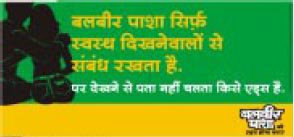
Pasha sirf swastha dikhnewalon se sambandha rakhta hai. Par dekhne se pata nahi chalta kise AIDS hai.
Aao milkar haath badhaye Balbir Pasha ko AIDS se bachaye.
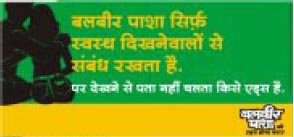
My observation was that the campaign was incredibly successful. I actually heard youngsters asking the right questions, look at the Billboards and having discussion about sex on the street. It was successful in removing the taboo because of the language used. Everyone could empathise. The man on the street knew that Balbir Pasha was just like him. He drank alcohol, visited brothels and wondered about AIDS.
The Balbir Pasha campaign however ran into trouble and was shut down in mid 2003. And no, it wasn’t because the Balbirs and Manjulas of the world approached the courts to file a defamation suit against the ad agency. Nor was it the bloggers’ favourite punching bags, government or Shiv Sena, playing killjoys, as is their wont when it comes to such bold themes. The script unfolds like an Agatha Cristhie novel. The most unlikely suspect is the culprit. It was actually the NGO’s and our dear Ms. Shobhaa De who came down hard on the campaign. They found the campaign incredibly sexist as they thought it was sending the wrong message regarding women. They were worried that people may assume that only women spread AIDS.
To their credit, the perpetually whiny NGO’s for once got carried away with the creative energies unleashed by the ad campaign. I remember one particular person opposing it had said.
Pasha Ho Yaa Asha AIDS Se Na Bane Jindagi Tamasha.In my book, the award for 'fostering public and private sector cooperation in an unlikely medium like public sevice advertising,’ went to Amul. Those guys are utterly butterly devilicious! They used the same format of the poster, the same colour combination, woman's silhouette et. all and created the following slogan:-
"Balbir Pasha roz savere kiske saath jaagta hai." with a Amul Butter in the same font as Balbir Pasha with "Regular Item' printed below. I mean seriously these guys should be worshipped.
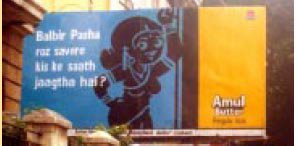
The government pulled down the campaign and the last I heard it was reinstatedwith newer posters and themes in November 2004. So if anybody Mumbaikar can provide the new slogans please share them here, I am eager to know Pasha’s recent antics.
As an aside, how much I miss advertisements from India!!! In comparison to the stock ‘100 percent APR financing’ ads in the US, they are so rich, layered, quirky and a zillion times creative and fun. I think advertising more than Bollywood or any other clichéd entity, serves as the symbol of national integration. Advertisements truly unite us across class/caste/language and religious barriers. Bollywood movies have their own target audience which varies from class, rural/urban etc. Whereas everyone can relate to ‘washing powder Nirma’ jingle or the ‘Deepikaji aaiye aaiye aapka sab saman tayar hai’ baritone inspite of the fact the buyer comes from a upper class background and has never bought anything but Aerial and Surf Excel.
Lekin ek baat kehana to hum aapse bhool hi gaye…. Ghabraiye nahi hume kuch nahi chahiye… Hum to bas itana chahte hai ki aap world AIDS day ka celebration Balbir Pasha ka naam leke kijiye.